Organizations these days have to deal with sneaky cyber threats that can get around the usual security measures. That is why doing red team penetration testing has become an important thing to do to see how well the security controls work against real attacks. By pretending to be the guys the red teams find weaknesses that the automated tools or regular security checks often miss.
The real benefit of doing these tests is seeing how well they work. In this blog we will talk about the things that companies should measure to see if their red team tests are working, like how long it takes to detect a problem how well they respond to it and how well they protect the most important things. We will also look at how these measurements help companies get better and better at working as a team to stop attacks, which is what we call purple team maturity. Red team engagements are very important. Companies need to measure things, like detection time and response accuracy to see if their red team engagements are working.
Why metrics matter in Red Team and Blue Team collaboration?
The red team does a lot of work to find out what is going on. If we do not get any real results from it then it is not very useful. When we use metrics, we can actually do something with what we have found. This helps the people in charge of security see if the things they are doing to protect us are working better over time. They can also see if the money they are spending on tools and training is worth it.
When the red team and the blue team work together metrics are really important. The red team tries to attack us. The blue team tries to defend us. Metrics help us connect what the red team finds with what the blue team can do to improve. Each time we do this we learn something. The red team shows us how someone who is trying to hurt us can get around our protections. Then the blue team uses that information to get better at finding and stopping attacks. The people, in charge can see how we are doing by looking at some numbers that tell us if we are getting better or not. The red team and the blue team use these numbers to make sure they are working together to keep us safe.
Key metrics for measuring Red Team penetration testing effectiveness
To assess how effectively security defenses perform during red team operations, organizations should focus on metrics that evaluate detection, response, and asset protection. These KPIs provide a comprehensive view of defensive maturity.
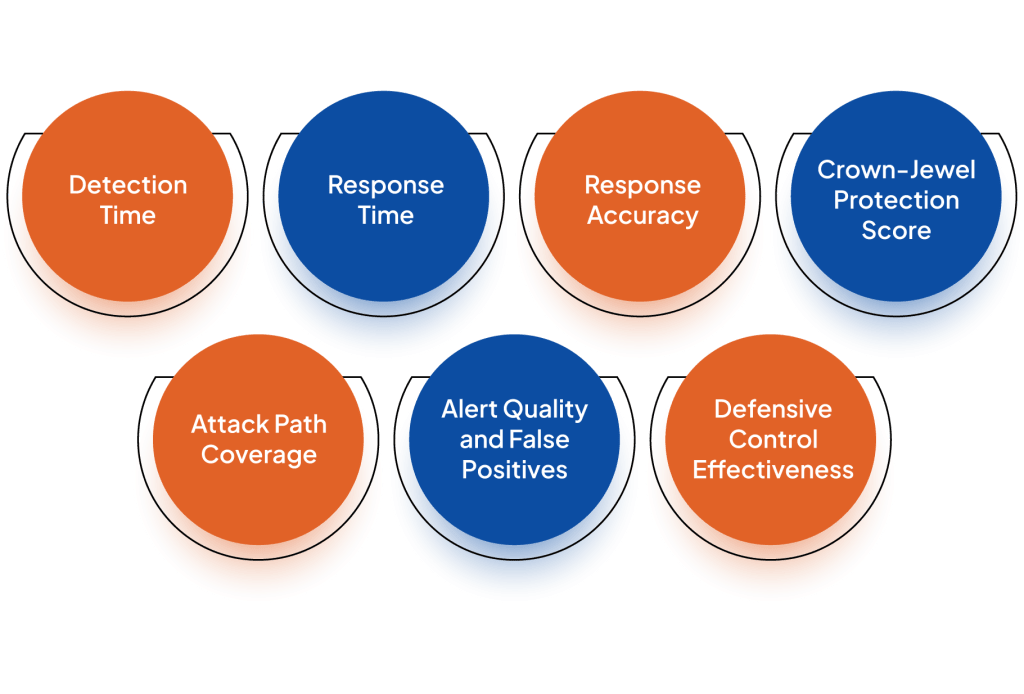
1. Detection Time
Detection time measures how long it takes for the security team or monitoring tools to identify malicious activity simulated during a red team engagement. Shorter detection times indicate that monitoring systems, security information and event management (SIEM) tools, and threat detection capabilities are functioning effectively. Longer detection times may reveal gaps in log visibility, monitoring coverage, or alert prioritization.
Tracking detection time over multiple red team penetration testing cycles helps organizations determine whether detection capabilities are improving. Ideally, as purple team collaboration strengthens, detection time should decrease steadily.
2. Response Time
Detection alone does not stop an attack. Once suspicious activity is identified, the security team must investigate and respond quickly. Response time measures how long it takes from the moment a threat is detected to the moment containment actions begin. During red team pen testing, this metric highlights the efficiency of incident response procedures. If the response time is slow, the issue may lie in unclear escalation procedures, understaffed teams, or insufficient automation. Organizations often use response time metrics to refine incident playbooks and improve coordination between analysts, incident responders, and leadership.
3. Response Accuracy
Speed is important when it comes to security. Getting things right is just as important. The security team needs to be able to figure out what kind of attack is happening and do the thing to stop it. This is called response accuracy. During a test where a red team tries to break in the people defending might see something but not understand how bad it is or where it is coming from. This can cause them to do the things to fix it or even stop the business from working properly.
If the security team is good, at response accuracy it means they know about the ways people can attack, and they know how to use the information they have to make the right decisions fast. Doing purple team exercises really helps with this because the defenders can learn from what the red team’s doing.
4. Crown-Jewel Protection Score
Not all assets within an organization carry the same level of risk. Critical assets-often referred to as “crown jewels”-include sensitive data repositories, intellectual property, financial systems, and core infrastructure. The crown-jewel protection score measures whether the red team was able to access or compromise these critical assets during testing.
A strong score indicates that layered defenses effectively prevent attackers from reaching high-value systems, even if initial entry points are exploited. If a red team successfully reaches crown-jewel assets, it signals that segmentation, privilege controls, or monitoring systems need improvement. Tracking this metric helps organizations prioritize defensive efforts around the systems that matter most.
5. Attack Path Coverage
Attack path coverage measures how many potential attack routes are tested during a red team engagement. Modern attackers rarely rely on a single exploit; they chain together multiple techniques to reach their objectives.
A mature red team pen testing program evaluates several pathways, including:
- Phishing-based initial access
- Credential harvesting and privilege escalation
- Lateral movement within internal networks
- Data exfiltration simulations
By expanding attack path coverage over time, organizations gain deeper visibility into how resilient their environment is against diverse attack strategies.
6. Alert Quality and False Positives
Security monitoring systems often generate thousands of alerts, many of which may not represent real threats. Red team exercises provide an opportunity to evaluate how well these alerts reflect genuine malicious activity.
Metrics in this category include:
- Percentage of red team actions that triggered alerts
- Number of alerts correctly classified as malicious
- Rate of false positives
Improving alert quality reduces analyst fatigue and ensures that real threats are identified quickly. Purple team collaboration often focuses on refining detection rules and tuning security tools to improve this metric.
7. Defensive Control Effectiveness
Defensive control effectiveness measures how well specific security tools and policies perform during a simulated attack.
Examples include evaluating the performance of:
- Endpoint detection and response (EDR) tools
- Network intrusion detection systems
- Identity and access management controls
- Data loss prevention mechanisms
Red team penetration testing helps determine whether these tools are configured correctly and whether they can detect and block sophisticated attack techniques.
Turning metrics into Purple Team improvement
Collecting metrics alone does not guarantee better security outcomes. The real value comes from analyzing results and using them to guide continuous improvement.
A mature purple team workflow typically follows these steps:
- Conduct red team testing to simulate realistic attack scenarios.
- Measure performance using predefined KPIs such as detection time and response accuracy.
- Review results collaboratively between red and blue teams.
- Update detection rules, response procedures, and security controls.
- Repeat the exercise and track improvement across testing cycles.
Over time, this iterative process transforms red team findings into measurable defensive growth. Security teams gain better visibility into attack behavior while defenders refine their ability to detect and respond quickly.
Building a security maturity dashboard
To effectively track progress, many organizations create dashboards that visualize red team penetration testing metrics. These dashboards allow security leaders to monitor trends such as:
- Reduction in detection time across testing cycles
- Improvement in crown-jewel protection scores
- Increased alert accuracy
- Faster incident response times
Visualizing these trends helps demonstrate the value of security investments and provides executives with clear insights into risk reduction. Additionally, dashboards encourage accountability by making security performance transparent across teams.
Conclusion
Red team exercises are a good way to see how well a company can protect itself from cyber-attacks. The real benefit of red team testing comes when we look at the results and use them to make the company’s defenses. We can use things like how it takes to detect an attack how well we respond to it and how well we protect our most important information to get a clear idea of how well the company can handle a real attack.
When we work together with a team the red team testing becomes more than just a practice attack. It becomes a way for the company to keep learning and getting better. By keeping track of things and making our defenses better after each test the company can get better at detecting attacks responding to them and keeping important things safe. Red team exercises help the company to keep getting better. Red team testing makes sure the company is ready for attacks. Want to check and improve your organizations security readiness? Doing structured red team penetration testing with metrics can help you find gaps. It can also help you make your defenses stronger and improve your team. With the help and guidance, from ValueMentor you can start checking the right KPIs today. You can turn attacks into real cybersecurity improvements.
FAQS
1. What is the purpose of red team penetration testing?
The purpose of red team penetration testing is to simulate real cyberattacks and evaluate how well an organization’s defenses can detect and respond to them.
2. What does a red team do during an engagement?
A red team attempts to exploit vulnerabilities, move through networks, and access sensitive assets while remaining undetected.
3. What is purple team maturity?
Purple team maturity refers to the level of collaboration between offensive (red) and defensive (blue) teams to continuously improve cybersecurity defenses.
4. What is detection time in red team exercises?
Detection time measures how long it takes for security tools or analysts to identify malicious activity during a simulated attack.
5. What is response accuracy in security testing?
Response accuracy measures how correctly the security team identifies an attack and applies the appropriate mitigation steps.
6. What are crown jewels in cybersecurity?
Crown jewels are an organization’s most critical assets, such as sensitive data, intellectual property, or key business systems.
7. How do red team metrics improve security programs?
Red team metrics provide measurable insights that help organizations strengthen detection systems, incident response, and overall security posture.
8. What tools are commonly used in red team testing?
Red teams often use tools for reconnaissance, privilege escalation, lateral movement, and phishing simulations to mimic real attackers.
9. Can small organizations benefit from red team pen testing?
Yes, even smaller organizations can benefit by identifying security gaps and improving their ability to detect and respond to threats.
10. What outcome should organizations expect from red team testing?
Organizations should gain actionable insights, improved detection capabilities, and stronger collaboration between security teams.