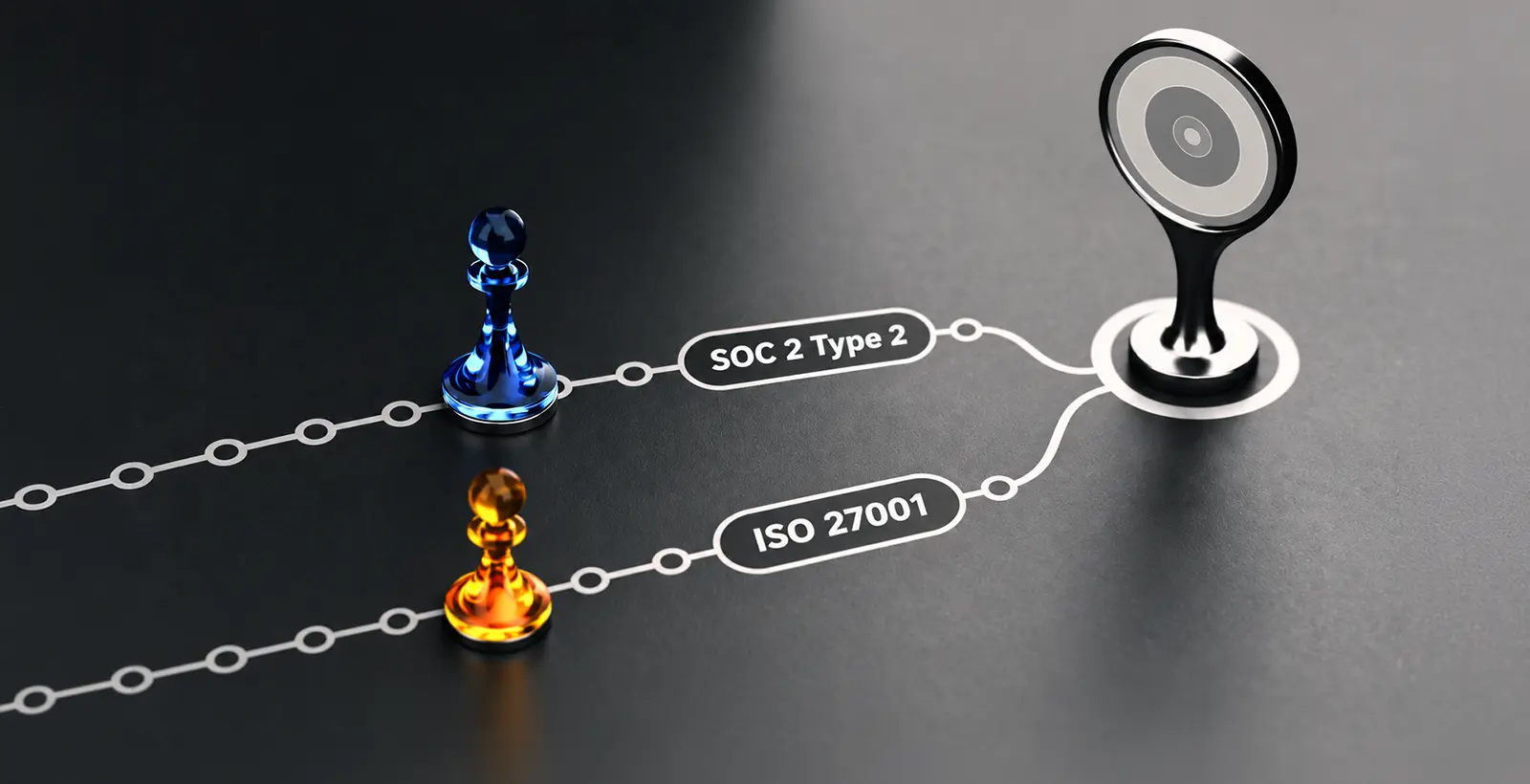
- Enterprise buyers have shifted their approach to seeing either SOC 2 or ISO 27001 certification as a minimum procurement requirement, not as something that sets them apart from others.
- SOC 2 is the leading certification for SaaS businesses in North America, while ISO 27001 holds more relevance in Europe, the Middle East, and the international enterprise world.
- SOC 2 Type 2 shows a company’s ability to maintain operational controls over an extended period of time and therefore, is much more reliable in the process of selling to enterprises compared to Type 1.
- ISO 27001 certification implies that the company has an information security management system, and is thus committed to information security on a systemic and organizational level.
- There are a lot of successful SaaS and tech companies who hold both certifications to avoid any compliance issues with different clients.
If you sell your software or services to enterprises, the simple answer would be – Yes, you definitely need to get one of those certifications and maybe even both.
The decision is not whether to go after any certification at all, but rather what certification should be your priority and why. For CISOs performing vendor risk assessments and SaaS founders struggling with their first enterprise sales process, the difference between SOC 2 and ISO 27001 has business implications. Pick the wrong one for your target market, and you’ll spend several weeks into a contract negotiation only to realize a mismatch in compliance requirements via procurement questionnaire, thus putting your deal in jeopardy.
This blog is meant to help you make the right choice. We will explore what requirements each of the frameworks entails, how enterprise buyers in various markets perceive each of them, and how a high-performing compliance strategy can look like while scaling up. No matter if you are a startup founder negotiating your first enterprise deal, or a compliance specialist trying to rationalize your existing security program, you will find this blog useful.
SOC 2 vs ISO 27001: Understanding the Core Difference

This point matters because enterprise buyers from different geographies are asking for different things. An American-based financial services company assessing a SaaS vendor would ask for a SOC 2 Type 2 report. A European logistics company or an organization from the Middle East will be more interested in ISO 27001 certification. Both are not the same documentation as each serves a different purpose. The first one addresses one question while the second answers another one.
SOC 2 is built on the basis of Trust Service Criteria, and its assessment is carried out by an authorized CPA firm. The result of the process is a report rather than a certificate. This report is confidentially shared with the buyers and prospects and contains information about what control measures you have and how they performed (in Type 2). ISO 27001 is a certification, which means that once passed successfully, you get a certificate that is public.
What Enterprise Buyers Actually Look For?
The procurement teams and CISOs are essentially evaluating the same core issue – is the vendor safe to handle our data? Both certifications prove the same point, but they do so from a different angle. SOC 2 shows the buyer how your security processes look under the hood on a controls level. ISO 27001 proves to them that your organisation has adopted a systematic way of managing its information security risks. Neither one of them is better than the other – what is crucial is compatibility with the buyer’s compliance landscape.
Security Certification for Enterprise Customers: What the Procurement Process Really Requires?
Having gone through any enterprise sales cycle over the last several years, you must have seen this change first-hand. The security assessment questionnaires are longer now. Legal departments bring up security posture issues earlier in the process. And in highly-regulated industries such as financial services, healthcare, government and critical infrastructure the need for third-party security certification is almost always non-negotiable. The question “Do you have SOC 2 or ISO 27001?” has become just as common as asking about a company registration number.
For SaaS founders and compliance managers, the takeaway is that waiting until there is a problem is not the approach to take. Large companies generally have well-defined vendor risk management programs, and showing up at the security review phase without the necessary documentation will only hinder the sales process or kill the deal outright. The difference between those who sell to enterprises regularly versus those who are stuck in perpetual security reviews all lies in the positioning of the certification process as an enablement function.
Industry-Specific Nuances
It should also be noted that not all industries have equal requirements of this type. Firms dealing with financial services or healthcare will always have the most stringent security requirements on vendors, including specification of the exact security standard and the timeframe and extent of the audit. Buyers from the technology industry will usually have a little more flexibility in form, but not substance; they can be expected to maintain the same high standard.
Requirements of Enterprise Buyers in terms of Compliance: Geography and Market Determine the Way to Go
This is not an absolute, but it is true often enough to serve as a good baseline. SOC 2 was developed in the United States and continues to dominate North American enterprise buyers. The AICPA framework is well-known to US purchasing organizations, and the SOC 2 Type 2 report is a well-recognized document in US enterprise vendors’ audits. If your main growth area is North America, it makes sense to go for SOC 2 Type 2 certification first.
ISO 27001, however, is an internationally recognized framework. The standard is highly respected not only in Europe but also in the Middle East, Asia-Pacific region and Latin America. For businesses working in the UK and EU environment after Brexit, ISO 27001 standards frequently match GDPR requirements perfectly, increasing its value even further. In jurisdictions with GDPR-like regulations such as the PDPL in the UAE, the DPDP Act in India and APAC privacy laws, ISO 27001 serves as a trustworthy international indicator of compliance maturity.
When Dual Certification Is the Smart Move to Make
For organizations that are currently rapidly expanding into different geographical regions or serving enterprise customers in North American and international markets, dual certification approach will remove friction points on a grand scale. Fortunately, there is a high level of convergence in terms of controls in the two frameworks. A properly designed compliance program will allow addressing both at the same time without doubling the effort. Designing your compliance program from scratch by an experienced partner will be much more effective than applying one framework to a program tailored to another framework.
SaaS Compliance Frameworks: Choosing the Right Foundation for Scale
SaaS organisations are presented with their own unique compliance challenge. These businesses will often have products which involve handling customer data at scale, are updated constantly, and operate in a distributed manner using cloud computing technology. SOC 2 and ISO 27001 both fit quite well into this kind of organisational structure, but each places its own requirements on the internal security programme in the organisation. SOC 2 focuses on controls and audit, which works great for SaaS companies with slim compliance teams needing to show particular assurances to the customer. ISO 27001 focuses on processes and systems, which works great for building an enduring security culture in the business.
Common Mistakes in SaaS Compliance Programmes
The most common mistake we come across in SaaS compliance programmes is picking a framework because of a single enterprise client requesting it rather than the actual needs of the market that your organisation is trying to reach with the product. Securing a deal with an enterprise client and rushing to get your first SOC 2 report together, only to find out the following ten clients you speak with are in Europe and ask for ISO 27001, is something which can be avoided.
The other common mistake organizations make is thinking of compliance as a one-time activity as opposed to a continuous program. SOC 2 Type 2 requires that the control operates over a certain period of time and is not something you can prepare for in a month. ISO 27001 requires a continuous improvement cycle and surveillance audits. In both cases, organizations that integrate security into their operational cycle will do better as compared to those preparing annually for the audit.
SOC 2 Type 2 Certification: Why Type 2 Is the Enterprise Standard
SOC 2 Type 1 provides an evaluation on whether the controls you have are adequate at that specific moment of time. Type 1 can be useful; however, its usefulness is limited since it is usually requested by start-up organizations that need to demonstrate some progress in their compliance program. Enterprises that purchase services from organizations have too much experience of seeing SOC 2 Type 1 reports to believe that adequate design implies operational effectiveness.
The observation period for a SOC 2 Type 2 audit will span six to twelve months. Within that time frame, your controls must run effectively and as intended. And it is in this regard that most organisations face their first big hurdle of meeting regulatory standards – the inconsistency between how they claim they operate according to their policies and how they actually operate. Paper access reviews, incident response processes documented but never exercised, patch management timelines specified but never adhered to – this is the kind of gap that will show up in a Type 2 audit process, leading to a lack of confidence among enterprise buyers once the results of the audit are released.
Preparing for Type 2: A Readiness Approach
Adopting a readiness approach to a SOC 2 Type 2 instead of a checklist approach can make all the difference in the outcome of the audit process. Those organisations that prepare by validating their security operations during the observation period tend to get better audit results, shorter audit times, and greater client confidence. Your compliance programme and security programme must be one and the same.
ISO 27001 Certification and Customer Security Requirements: What Certification Actually Signals
The ISMS requirement is the critical component that defines the uniqueness of ISO 27001. It is not just the list of technical controls to be put in place. It is rather a management system, which makes you analyze the security risks in your company systematically and then deploy the control measures proportionate to these risks and manage the whole process. This systemic approach is important for enterprise buyers in particular.
There are two stages of the auditing procedure involved in ISO 27001 certification. The first one is the document audit where the auditor evaluates whether the ISMS meets the standard. The second stage of the auditing procedure is the implementation audit when the auditor evaluates whether the ISMS works the way it is described in the document. The certification process is valid for three years with the annual surveillance audits required.
ISO 27001 and Regulatory Alignment
Another benefit of the ISO 27001 system is its ease of alignment with other regulations. GDPR article 32 obliges the parties to apply adequate technical and organisational measures for ensuring the protection of personal data, while the ISO 27001 ISMS framework is generally regarded as a suitable means for demonstrating that such measures are in place. The same holds true in the case of the NIS2 directive, UAE IA Regulations, and various sector-specific frameworks. For compliance professionals facing the task of meeting multiple regulatory requirements, ISO 27001 could act as a kind of a common architecture that streamlines compliance efforts.
Conclusion
Ultimately, choosing between the SOC 2 Type 2 report and the ISO 27001 certification is a strategic choice dictated by the geography of your operations, customer profile, and growth plans. Both compliance tools require significant investment of time and resources into building up adequate security posture that will pass an independent verification by enterprise customers. In the current environment, this is often a must for any SaaS company or technology vendor.
As we move forward, there is no doubt as to where things are headed; enterprise compliance policies will become stricter, procurement security questionnaires will become more complex, and those organisations that regard their certification as a building block, not just a certificate, will be the ones to enjoy a true competitive edge. Irrespective of whether you plan to start off with SOC 2 Type 2, work towards ISO 27001, or both, the idea is to prove yourself through data as an organisation that can be trusted. It is an important standard to live up to.
Confused about which certification to pursue first for your business? Visit ValueMentor to explore how our compliance advisory team assists SaaS and mid-market enterprises in establishing their security programmes that will pass an audit irrespective of your initial focus on SOC 2 or ISO 27001.
FAQs
SOC 2 is a US-based audit attestation that assesses a service organisation’s processes for protecting customer data based on the Trust Service Criteria. On the other hand, ISO 27001 is an international certification that requires an organisation to have a formal information security management system.
Which one is more appropriate for my business – SOC 2 or ISO 27001?
Neither of these standards is better than the other; they are just different. SOC 2 is better for organisations whose main target customers are enterprises in North America. ISO 27001 is better in case of Europe, Middle East and international markets.
Is SOC 2 harder to get than ISO 27001?
Both frameworks have similar organisational needs in terms of commitments. However, while SOC 2 Type 2 requires an observation period of six to twelve months for independent auditors to evaluate operational controls, ISO 27001 requires an ISMS and two-step audits. Both are neither easy nor quick processes.
Can a business have both SOC 2 and ISO 27001 certifications at once?
Indeed, getting both these certificates at once not only feasible but highly recommended. Both frameworks have many overlapping requirements for controls and can be combined into a single compliance strategy. Dual certification eliminates procurement challenges across various geographical locations and demonstrates enterprise-level security maturity.