
SOC 2 compliance is one of the most requested assurances from clients and partners when evaluating service providers. The framework requires organizations to implement strict controls across security, availability, processing integrity, confidentiality and privacy. Unlike general security compliance requirement, SOC 2 is audit-driven and evidence-based, which means companies must demonstrate that their controls are not only designed correctly but also operating effectively. This SOC 2 requirements checklist breaks down the detailed SOC 2 requirements, explains the SOC 2 attestation requirements and highlights the practical steps needed to prepare. Whether your organization is targeting a Type I or Type II report, understanding these requirements upfront helps reduce audit delays, close control gaps and provide stronger assurance to stakeholders.
What Are SOC 2 Requirements?
SOC 2 requirements are a set of standards developed by the American Institute of Certified Public Accountants (AICPA) to ensure that organizations handle customer data securely and responsibly. To meet SOC 2 requirements, a company must establish and maintain controls that demonstrate it can:
- Protect systems and data from unauthorized access
- Ensure services remain available and reliable
- Process information accurately and completely
- Safeguard confidential information from misuse or disclosure
- Manage personal data in line with privacy commitments and regulations
SOC 2 Requirements Checklist: Step-by-Step
Meeting SOC 2 requirements checklist can feel complex without a clear plan. A structured checklist helps organizations align with the Trust Services Criteria and prepare for a successful audit. Below is a step-by-step guide:
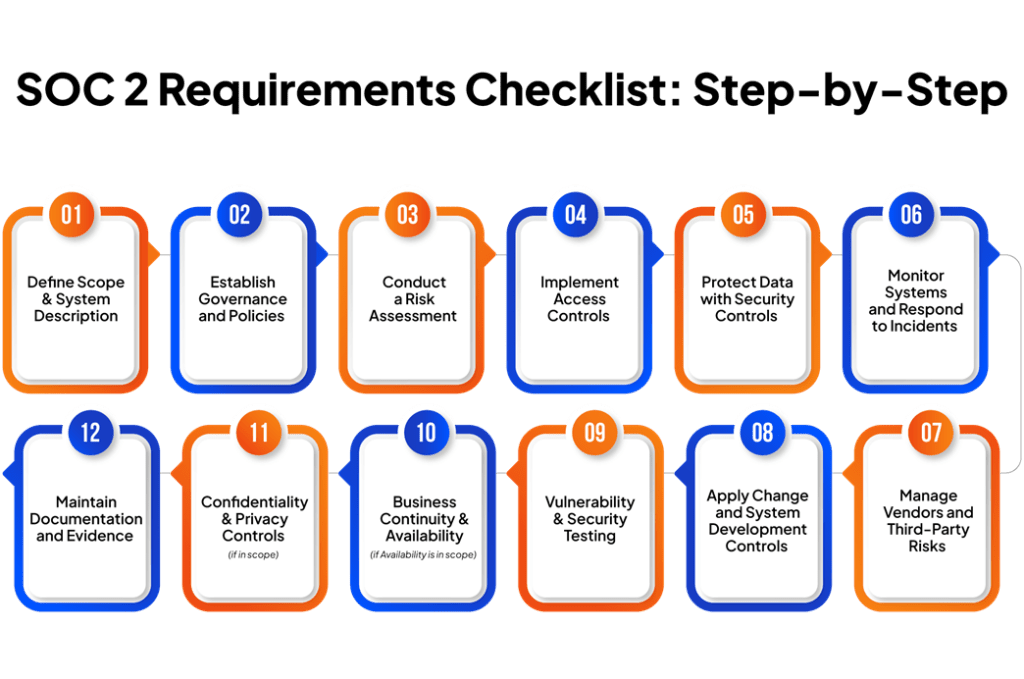
- Define Scope & System Description – Identify the in-scope system, data flows, boundaries, locations and relevant TSC categories.
- Establish Governance and Policies – Define security policies, assign responsibilities and set clear accountability for data protection and compliance.
- Conduct a Risk Assessment – Identify risks to data, systems and operations. Document how those risks are managed, mitigated or accepted.
- Implement Access Controls – Restrict data and system access based on roles. Use multi-factor authentication and strong identity management practices.
- Protect Data with Security Controls – Apply encryption for data in transit and at rest. Use firewalls, endpoint protection and secure configurations.
- Monitor Systems and Respond to Incidents – Deploy logging, monitoring and alerting solutions. Create an incident response plan to detect and address security events quickly.
- Manage Vendors and Third-Party Risks – Evaluate the security practices of vendors who handle sensitive data. Maintain contracts and monitoring procedures.
- Apply Change and System Development Controls – Ensure system updates and changes are tracked, tested and approved before implementation to avoid security gaps. Apply secure SDLC practices.
- Vulnerability & Security Testing – Run vulnerability scans, track remediation SLAs, and perform periodic penetration testing scoped to the system and network segments in scope.
- Business Continuity & Availability (if Availability is in scope) – Define RPO/RTO, test backups and restore, document DR procedures, and perform resilience tests.
- Confidentiality & Privacy Controls (if in scope) – Classify data, restrict handling, apply retention/disposal, and ensure privacy notices, consent, and rights handling align with commitments.
- Maintain Documentation and Evidence – Keep records of policies, procedures, system logs and audit trails. This documentation is critical for the SOC 2 audit process.
Types of SOC 2 Reports: Type I vs. Type II
SOC 2 reports come in two forms Type I and Type II – and the choice depends on the maturity of your controls and the expectations of your customers.
SOC 2 Type I
- Evaluates whether the organization has designed appropriate controls to meet the Trust Services Criteria.
- Focuses on a specific point in time rather than continuous operation.
- Useful for businesses preparing for their first audit or looking to demonstrate initial compliance and get to market sooner.
SOC 2 Type II
- Assesses whether controls were designed and operating effectively over a defined period (commonly 3 – 12 months; many choose 6 – 12).
- Grants stronger assurance to customers because it proves continuous use of controls in actual circumstances.
- Typically requested by enterprise partners and customers as evidence of continuous compliance.
Key Difference
- Type I – shows that controls are in place.
- Type II – proves that controls work as intended over time.
Organizations usually begin with Type I to establish a foundation and then move to Type II to meet stricter customer and market demands.
Common Challenges in Meeting SOC 2 Requirements
SOC 2 compliance demands technical and operational discipline that must be maintained continuously. Most organizations grapple with some of the following challenges that make it difficult or slow to obtain attestation:

1. Policies exist but don’t match practice
SOC 2 audits necessitate full documentation of security, availability, confidentiality and privacy controls. Most companies do not map written policies to practice and that creates gaps during audits.
2. Gaps in identity & access management
Incorrect role definitions, absence of multi-factor authentication and inadequate privilege reviews cause vulnerabilities. Auditors seek to impose strict least privilege and hold frequent access reviews.
3. Weak logging/monitoring
Lack of centralized storage of logs or the deployment of Security Information and Event Management (SIEM) tools hinders control effectiveness proof. Without effective audit trails, anomalies and incidents are not detected.
4. Vendor Risk Oversight
Third-party vendors dealing with sensitive information need to be audited and monitored. Most companies do not have formalized vendor risk management programs, security terms in contracts or compliance checks on a regular basis.
5. Ineffective Change Management
Undocumented system changes, delayed approvals or insufficient test environments could lead to audit findings. SOC 2 demands regulated processes for software patches and config changes.
6. Collecting Evidence and Preparing for Audit
Organizations very rarely have enough audit-ready evidence. Incomplete penetration tests, no reports of vulnerabilities or outdated risk assessments are the reason for attestation bottlenecks.
7. Treating SOC 2 as a one-time project
SOC 2 is not a project but a process. There should be continuous monitoring, regular risk review and policy update to prevent compliance drifting between audits.
Best Practices for a Smooth SOC 2 Audit
A SOC 2 audit’s success is dependent on planning and the stability of operations. The below best practices enable organizations to drive the process efficiently and steer clear of typical pitfalls:
1. Run a Readiness (Gap) Assessment
Arrange a pre-audit gap analysis to determine missing controls, superseded procedures or gaps in documentation. These are fixed prior to minimize delays during the formal audit.
2. Standardize & Enforce Policies and Procedures
Ensure all security, confidentiality and privacy policies are written, approved and implemented in practice. Policy statements are attested to by auditors who check for enforcement.
3. Secure Access by Design
Apply the least privileged principle, implement multi-factor authentication and regularly review access. Keep detailed records of role changes and privilege changes.
4. Centralize Logging and Monitoring
Utilize log management software or SIEM to record system activity, access attempts and security events. Correlate the logs to show comprehensive monitoring and incident detection.
5. Institutionalize Vendor Risk Management
Utilize security questionnaires, compliance certificates and terms of contract to assess third-party service providers. Update records on tests and continuous monitoring.
6. Put in place Structured Change Management
Enforce documented approvals, testing and rollbacks for system and software changes. Auditors will appreciate version control and controlled deployment practices.
7. Maintain Audit-Ready Evidence
Collect audit logs, vulnerability scan reports, penetration test results and incident response documents periodically throughout the year. Having evidence in one location prevents last-minute data collection.
8. Take Advantage of Automation Where It Applies
Compliance automation tools simplify evidence collection, control monitoring, and reporting. They help ensure audit-ready documentation is gathered continuously, demonstrate control effectiveness, and generate compliance reports with minimal manual effort.
How Consulting and Automation Solutions Simplify SOC 2 Compliance
SOC 2 compliance demands ongoing monitoring, in-depth documentation and mapping to the Trust Services Criteria. Manual processes are susceptible to delay, inconsistent evidence and burnout for auditors. Advisory support and automation platforms allow for efficiency by bridging both strategic and operational gaps.
Role of Consulting Partners
- Perform readiness assessments to discover control gaps and develop remediation plans.
- Help design and implement controls pertinent to SOC 2 requirements.
- Assist in preparing audit evidence and audit readiness through AICPA expectation alignment.
- Create sustainable long-term compliance systems longer than the audit cycle.
Role of Automation Solutions
- Collect and organize evidence automatically across systems and processes.
- Monitor controls in real time, reducing reliance on periodic manual reviews.
- Standardize reporting, making compliance status clear for both management and auditors.
- Reduce human error by replacing spreadsheets and manual tracking with automated workflows.
Combined Value
Consulting ensures that controls are properly designed and mapped to business operations, while automation ensures they are continuously validated and documented. Together, they shorten audit timelines, reduce operational overhead and provide stronger assurance of compliance.
Conclusion
SOC 2 compliance is a critical step for building trust with clients, protecting sensitive information and meeting industry expectations. Achieving attestation requires a structured approach that combines strong governance, well-implemented controls, continuous monitoring and audit-ready documentation. Organizations that prepare early, address control gaps and adopt automation alongside expert guidance can complete the audit process with greater efficiency and confidence. If your business is preparing for SOC 2 attestation and reporting, ValueMentor can help you design controls, streamline compliance workflows and guide you through every stage of the audit. Explore our SOC 2 Compliance Services to get started with a tailored compliance strategy.
FAQs
1. What are SOC 2 requirements?
SOC 2 requirements are AICPA Trust Services Criteria controls which are directed towards security, availability, processing integrity, confidentiality and privacy. Organizations have to implement, design policies, technical safeguarding and evidence-based processes for achieving these requirements.
2. Who needs SOC 2 compliance?
SOC 2 compliance is top priority for technology companies, SaaS companies, cloud computing companies and any company that stores, processes or has customer information.
3. What is a SOC 2 requirements checklist?
A SOC 2 checklist consists of governance policies, risk assessment, access control, data protection, system monitoring, incident response, vendor risk management, change management and evidence documentation.
4. How does SOC 2 Type I and Type II differ?
Type I decides whether controls are properly designed at a particular point in time. Type II checks the operating effectiveness of such controls over a specified period, typically six to twelve months.
5. How soon will you be SOC 2 certified?
Timelines are prone to readiness. A Type I audit will be 2-3 months, and a Type II audit will typically be 6-12 months of evidence collection before completion.
6. What are the biggest SOC 2 compliance issues?
Routine issues are poor documentation, poor access controls, poor monitoring, poor vendor management and inadequacy of evidence collection.
7. Does a small enterprise require SOC 2 Attestation?
Yes. Even small businesses seeking business clients or working with confidential data are usually required to supply SOC 2 reports to establish trust and fulfill contractual requirements.
8. What is evidence subject to audit in a SOC 2 audit?
Auditors normally review access logs, vulnerability scans, change management records, incident response reports, penetration test results and vendor risk assessments.
9. How can automation enable SOC 2 compliance?
Automation tools gather evidence in real time, scan controls round the clock and create audit-ready reports, eliminating manual labor and human mistake.
10. In what ways can ValueMentor assist with SOC 2 Compliance Reporting?
ValueMentor offers consulting services to create and implement SOC 2 controls, conduct readiness evaluations and navigate organizations through the audit process while utilizing automation for efficiency.