Data anonymization refers to the process of transforming or altering personal data in such a way that individuals cannot be identified directly or indirectly. The goal is to protect the privacy of individuals while still allowing for the analysis and utilization of data for various purposes, such as research, analytics, and business intelligence.
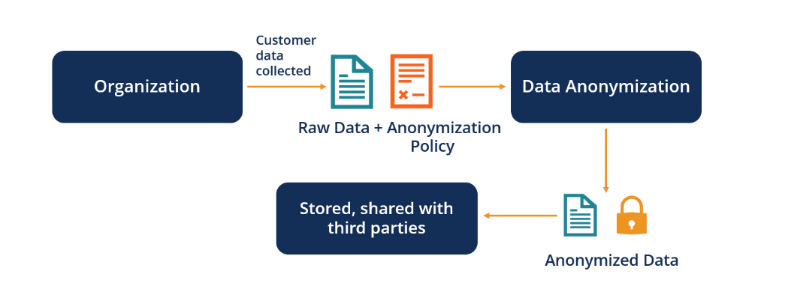
Data anonymization is crucial for privacy protection, ensuring individuals’ sensitive information remains secure from unauthorized access. It aids in regulatory compliance with laws like GDPR, UAE PDPL & Saudi PDPL and mitigates risks by reducing the impact of potential data breaches.
Data Anonymization Methods
Data anonymization involves transforming personal data to protect individuals’ privacy while enabling data usage. This includes techniques like masking, tokenization, generalization, and more. Let’s check them in detail.
- Data masking – involves altering data values, such as replacing characters with symbols like “*” or “x,” making identification or reverse engineering challenging and enhancing data anonymization. Also, encryption could be used to scramble the masking algorithm itself, making it more difficult to reverse the process.
- Tokenization – is another technique used for processing data securely and involves replacing sensitive data with a unique identifier or token. The original data is stored securely in an independent database, while the token represents the data in other systems.
- Generalization – intentionally excludes some data to reduce identifiability, modifying data into ranges or broad regions while preserving data accuracy.
- Data swapping – rearranges dataset attribute values, such as date of birth, to prevent original information disclosure and enhance anonymization.
- Data perturbation – marginally alters the dataset by rounding values or adding random noise, maintaining data utility while safeguarding privacy.
- Synthetic data – generation creates artificial datasets using mathematical models based on patterns in the original dataset, ensuring privacy and protection without compromising data utility.
Pros and Cons of Data Anonymization
Given below are the benefits, and challenges of protecting personal information while enabling data-driven insights.
Pros
- Renders person identification in a dataset nearly impossible
- Facilitates data sharing for legitimate purposes like analysis and research.
- Speeds up compliance with data privacy laws.
- Prevents unauthorized access to sensitive information.
- Lowers the risk of errors such as data linkage mistakes.
- Reduces costs associated with consent-free data reuse and secure storage avoidance.
Cons
- May diminish data utility by altering or removing critical Personally Identifiable Information (PII) elements.
- Could lead to reidentification if attackers cross-reference additional data.
- Might necessitate expertise and specialized tools, increasing complexity and cost.
- May not offer complete data privacy protection if reidentification is successful.
- Could be ineffective on highly sensitive or uniquely structured data.
- Can be time-consuming, resource-intensive, and lacking scalability.
Best Practices for Data Anonymization
Effective data anonymization requires a strategic approach. It involves defining clear anonymization goals, selecting appropriate techniques, implementing robust security measures, and continuously assessing and refining processes to ensure optimal privacy protection while maintaining data utility.
Define Anonymization Objectives
Before starting the anonymization process, set clear goals. Identify which data elements need anonymization and the extent to which it should be applied, balancing privacy protection and data utility.
Implement Cryptographic Strategies
Use cryptographic methods like tokenization or encryption to enhance data anonymization. Tokenization replaces sensitive data with random tokens, while encryption ensures data remains unreadable without decryption keys.
Regularly Review and Enhance Anonymization Tactics
Stay updated on the latest anonymization techniques and security protocols. Continuously monitor and improve strategies to maintain effective privacy protection against evolving threats.
Conclusion
In conclusion, data anonymization serves as a cornerstone for safeguarding privacy and promoting responsible data utilization in the modern digital era. Through the adoption of robust anonymization techniques, organizations can effectively mitigate privacy risks, adhere to regulatory mandates, and uphold ethical principles in their data handling practices.
Nevertheless, striking a delicate balance between privacy preservation and data usability necessitates continuous evaluation and adaptation to meet evolving regulatory standards and emerging threats. Only through vigilant oversight and proactive measures can organizations effectively navigate the complex landscape of data privacy and maintain the trust of stakeholders in an increasingly data-driven world.
Data anonymization is crucial for responsible data usage. Balance privacy with utility for optimal results. ValueMentor can help you navigate the complexities of data anonymization. Contact us for expert guidance.
FAQs
Data anonymization is the process of transforming personal data so individuals cannot be identified, helping organizations protect privacy while using data for business and research purposes.
It helps protect sensitive information, reduce privacy risks, and support compliance with regulations such as GDPR, UAE PDPL, and Saudi PDPL.
By removing or obscuring personally identifiable information (PII), anonymization helps organizations meet privacy requirements and reduce compliance risks.
Popular techniques include data masking, tokenization, generalization, data swapping, data perturbation, and synthetic data generation.
Yes. When implemented correctly, anonymization preserves data utility while minimizing the risk of exposing sensitive information.
Anonymization permanently removes the ability to identify individuals, while pseudonymization replaces identifiers but may allow reidentification under controlled conditions.
Although anonymization significantly reduces risk, poor implementation or combining datasets may create reidentification risks.
Common challenges include maintaining data accuracy, balancing privacy with usability, managing costs, and preventing reidentification.
The best approach depends on the type of data, business objectives, regulatory requirements, and the level of privacy protection needed.
ValueMentor helps organizations assess privacy risks, implement effective anonymization techniques, align with regulatory requirements, and strengthen their overall data protection strategy.