Nowadays, Machine learning drives a lot of the technology we rely on today. From autonomous vehicles to advanced healthcare devices, it is transforming how we work and live. But as with any system, it has vulnerabilities. Perhaps the most dangerous threat is called adversarial attacks. These are intentional attempts to mislead machine learning models into making incorrect choices.
If you are someone who wants to know more about Adversarial attacks, then you are in the right place. This blog will explore what adversarial attacks are, how they happen, the different forms they take, and how we can stay protected.
What Are Adversarial Attacks?
An adversarial attack happens when someone gives a machine learning model misleading input to fool it. These inputs are referred to as adversarial examples. They look entirely normal to the human eye. But they are specifically designed to mislead the AI.
These attacks are not just technical glitches. They are targeted attempts to find and exploit weaknesses in machine learning systems. As AI continues to spread into areas like machine learning in cybersecurity, fraud detection, facial recognition, and self-driving technology, the risks of these attacks grow more serious.
The Threat of Adversarial Attacks in Machine Learning
Adversarial attacks trick machine learning systems by using small, carefully made changes in the data. These changes may look normal to people, but they confuse the AI and cause it to make wrong choices.
One example is a car mistaking a camouflaged vehicle for a cake. That might sound funny, but in areas like healthcare or self-driving cars, these kinds of mistakes can be dangerous.
To stop this from happening, big companies like Google and Microsoft are working on ways to make AI safer. The European Union has also proposed ALTAI, a model for developing reliable AI systems. Even with increased awareness, most organizations do not have adequate defenses and only pay attention to conventional cybersecurity.
Examples of Adversarial Attacks
Example 1: Misleading Facial Recognition Systems

Suppose a security system applies facial recognition for screening individuals at a highly secure zone. Under normal circumstances, the system can identify a human being without any issue. But by applying a minor trick such as introducing a peculiar noise pattern, the system may become confused
In the above Figure 1 provided:
- The first picture is the original face, which the system identifies correctly.
- The second picture is an adversarial pattern that appears as random colorful noise.
- The third picture still appears the same to us, but to the AI, it’s a different person altogether.
This shows how an attacker could fool a facial recognition system without changing how the person looks to others. That could lead to someone sneaking into secure areas or impersonating someone else.
Example 2: Hiding Road Hazards from AI in Self-Driving Cars
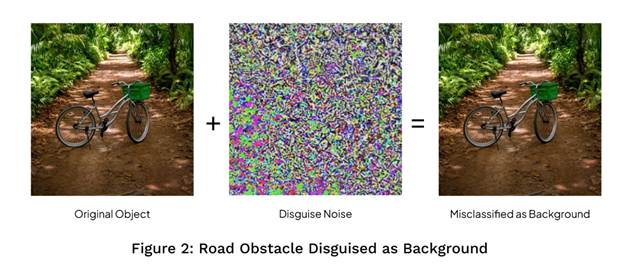
Autonomous vehicles rely on AI to detect objects on the road. But if a person embeds a unique pattern of noise within an object, such as a bicycle, then the vehicle may fail to detect it.
In the above given Figure 2:
- The first image shows a clear photo of a bicycle on a path.
- The middle image shows colorful noise used to trick the AI.
- The last image looks the same to us, but now the AI thinks the bike is part of the background.
This means the car might ignore it and keep driving. In real life, that could cause accidents.
What Is the Purpose of an Adversarial Attack?
The purpose of an adversarial attack depends on where it is used:
- Security Breaches: Attackers can fool facial recognition systems to bypass security and gain access as someone else.
- Financial Gain: Some use these attacks to trick trading systems or fraud detectors for money or personal benefit.
- Disruption: In machines like self-driving cars or drones, small tweaks can cause big errors. A car might miss a stop sign or take a wrong turn because of a few stickers on a road sign.
- Research and Testing: Security experts and researchers also use adversarial attacks. They do this to find weak spots in models. This helps make AI systems safer and more reliable before they are used in the real world.
Types of Adversarial Attacks
Adversarial attacks pose a significant threat to AI systems, and the type usually depends on how much the attacker knows about the system.
1. Poisoning Attacks
These attacks happen during the training phase. Instead of changing the model later, attackers feed it bad data from the start.
For example, they might add slightly incorrect or manipulated samples to the training set. These errors are hard to notice but cause the model to learn wrong patterns. A spam filter trained this way might start allowing harmful emails because it learned from bad examples.
Poisoning attacks are hard to detect because the damage is done before the system is even used.
2. Evasion Attacks
Evasion attacks happen after the model is trained. The attacker tweaks the input just enough to fool the model, without changing how it looks to people.
There are two main types as seen in Figure 3:
- Nontargeted attacks: Just aim to cause any wrong output. For example, making a stop sign unrecognizable to an AI, even if it gets labeled as something random.
- Targeted attacks: Try to make the model give one specific wrong result—like labeling a harmful file as safe.
These attacks work because machine learning models can be thrown off by tiny, well-planned changes.

How They Work
Adversarial attacks deceive machine learning systems by taking advantage of their pattern-detection capabilities, without needing access to networks or code.
Step 1: Learning the Model’s Behavior
Attackers learn the model’s behavior. In white-box attacks, they have direct access to the model’s design; in black-box attacks, they provide various inputs and observe the responses.
Step 2: Creating Adversarial Inputs
Attackers design subtle inputs, referred to as adversarial examples, that deceive the model. Such inputs are typically calculated mathematically, such as minor pixel movement in an image, which can trick the model.
Step 3: Exploiting the Model
The model calculates the adversarial input, which results in false outputs. This can lead to misidentification, wrong conclusions, or security breaches.
Step 4: Post-Attack Consequences
These attacks may lead to minor misclassifications or severe damage, like medical mistakes or security violations, and thus are particularly risky.
Defenses Against Adversarial Attacks
1. Training with Adversarial Examples
Training using adversarial examples makes the models robust against attacks. This defense makes the model stronger but needs a lot of time and computing power.
2. Hiding Gradient Information
Gradient masking conceals the information used by attackers to generate adversarial examples. It interferes with their process, although some sophisticated attacks may still get around it.
3. Reducing Sensitivity with Distillation
Distillation smooths out model predictions so that they are not as sensitive to small changes in inputs. Effective against low-level attacks, it can decrease accuracy on clean data and be evaded by sophisticated techniques.
4. Defense via Multiple Models Combined
Ensemble methods combine several models to enhance defense. This renders attacks less probable to succeed, but handling multiple models can be resource expensive.
5. Transform Inputs
Converting inputs, such as resizing or cropping, assists in minimizing attacks. But it can damage data quality and may not prevent all attacks.
6. Harden Models
Hardening methods secure models against input change fluctuations. They enhance stability but require periodic updates to manage new attacks.
7. Real-Time Monitor
Real-time monitoring can identify attacks by identifying unusual patterns. It assists in responding promptly, but it must be fine-tuned to prevent false alarms.
List of Popular Attack Methods and Their Effectiveness
1. Limited-memory BFGS (L-BFGS)
L-BFGS is an optimization strategy that reduces picture disturbances and generates adversarial samples. It is highly effective at subtle manipulation but is computationally demanding.
- Pros: Generates high-quality adversarial examples.
- Cons: Very resource-intensive and time-consuming, which makes it impractical for real-time use.
2. Fast Gradient Sign Method (FGSM)
FGSM is a quick, gradient-based attack that modifies image pixels to maximize misclassification. This method is straightforward and fast to apply.
- Pros: Efficient and fast.
- Cons: Perturbations affect all features, potentially making the attack easier to detect.
3. Jacobian-based Saliency Map Attack (JSMA)
JSMA focuses on modifying only the most important features of an input. It uses a saliency map to guide the changes and reduces the number of features altered, making it harder for defenders to spot the attack.
- Pros: Fewer changes to the input make detection more difficult.
- Cons: More computationally expensive compared to FGSM.
4. Generative Adversarial Networks (GANs)
GANs involve two neural networks in a competitive setting, where one generates adversarial examples, and the other tries to classify them as fake. This adversarial process enables GANs to create complex attacks.
- Pros: Capable of creating various and realistic adversarial examples.
- Cons: Training GANs is highly resource-intensive and can be unstable.
Difference Between Adversarial Whitebox vs. Blackbox Attacks
In a white-box attack, the attacker has full visibility into the model. They know its structure, parameters, and even the data it was trained on. With that knowledge, they can create specific inputs that are likely to fool the system.
Whereas a black-box attack denies the attacker such access. They don’t know how the model works internally. Instead, they rely on testing and observing how it responds to different inputs. Over time, this trial-and-error process helps them find weaknesses-making even black-box attacks a serious threat.
How Can You Protect Yourself Against an Adversarial Attack?
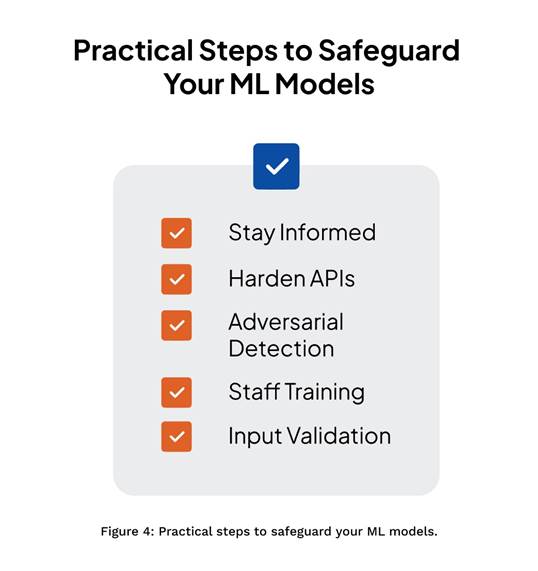
Best Practices for protects individuals and organizations:
- Stay Updated: Monitor AI security advisories from sources like NIST.
- Use Robust Models: Deploy systems with certified defenses or adversarial training.
- Limit Model Exposure: Restrict API access to prevent blackbox probing.
- Audit Inputs: Implement real-time input validation to catch anomalies.
- Educate Teams: Train staff to recognize phishing or social engineering tied to attacks.
Conclusion
Adversarial attacks reveal the vulnerabilities in machine learning systems, highlighting their fragility in an AI-driven world. As we move into 2025, where AI is integral to critical systems, addressing these weaknesses becomes crucial. Attackers exploit model flaws through evasion, poisoning, and subtle manipulations that are often undetectable by humans. However, strong defenses such as adversarial training, explainable AI, and collaborative, crowdsourcing solutions are emerging to fight these threats. We can build more resilient AI systems by knowing the various attack tactics, their effectiveness, and defense strategies. This will help to build public trust and keep AI secure. The struggle against adversarial attacks continues, but with continued innovation and attention, we can ensure a safer, more trustworthy future for AI.
FAQs
An adversarial attack manipulates ML model inputs to cause errors, like misclassifying images or text.
Models rely on numerical patterns, not human reasoning, making them sensitive to subtle input changes.
Targeted attacks aim for specific errors; untargeted ones cause any misclassification.
Yes, like stickers on signs fooling autonomous cars or hidden audio commands tricking smart devices.
It’s a defense method where models learn from attacks during training.
They’re rising, with 60% of models vulnerable, especially in vision and NLP.
An attack with full model access, allowing precise manipulation.
An attack without model details, using queries or transferable examples.
Yes, it crafts realistic adversarial examples, increasing attack sophistication.
They corrupt training data to compromise model performance.
Healthcare, automotive, and finance, due to heavy AI reliance.
Yes, like feature squeezing and explainable AI systems.
It speeds up attack calculations, making them stealthier.
By using updated systems, limiting API access, and auditing inputs.
Hybrid defenses with generative and explainable AI are leading the way.