
Machine learning systems are being used more and more in areas like finance and healthcare. This means we really need to make sure they are safe, from people who try to trick them. These bad people can make inputs that fool the machine learning systems into making wrong guesses. The weird thing is that these special inputs can be so small that people cannot even see the difference. Machine learning systems are also used in cybersecurity and autonomous systems, so we need to protect them from these people too. The special inputs that trick machine learning systems are called attacks. Machine learning systems and adversarial attacks are a problem because adversarial attacks can make machine learning systems do the wrong thing. Even models with very high validation accuracy can behave catastrophically when subjected to adversarial attacks.
Organizations that use ML to make high-stakes decisions need to look beyond the usual performance metrics and work to assess robustness. Creating an adversarial attack simulation lab within an organization allows them to systematically produce adversarial samples, assess model robustness in a controlled setting, and incorporate security into the ML development workflow. This guide will take you through a step-by-step process of creating a reproducible lab, choosing open-source tools, and incorporating robustness assessments into CI/CD pipelines.
Why you need an internal adversarial testing lab?
The traditional assessment workflows for ML stress the importance of accuracy, precision, recall, and F1-score. Although these are measures of performance on clean data, they fail to capture model behavior when exposed to adversarial or manipulated data. This is particularly problematic if models are not tested for adversarial behavior, as it leaves them vulnerable to attack until they are deployed.
An internal lab changes the paradigm from reactive to proactive. This enables organizations to model threat scenarios, compare robustness across different versions of models, and establish feedback loops between security and data science teams. This helps to build institutional knowledge and model robustness over time.
Key benefits include:
- Early identification of model weaknesses
- Standardized red-team testing procedures
- Quantifiable robustness benchmarks
- Automated regression testing for robustness
- Improved regulatory and audit readiness
In addition to the above benefits, having an adversarial testing lab within the organization promotes accountability and repeatability in AI security initiatives. This ensures that robustness is no longer a KPI that is considered in an abstract manner but is instead a measurable metric. This is achieved by integrating adversarial validation into the ML development lifecycle.
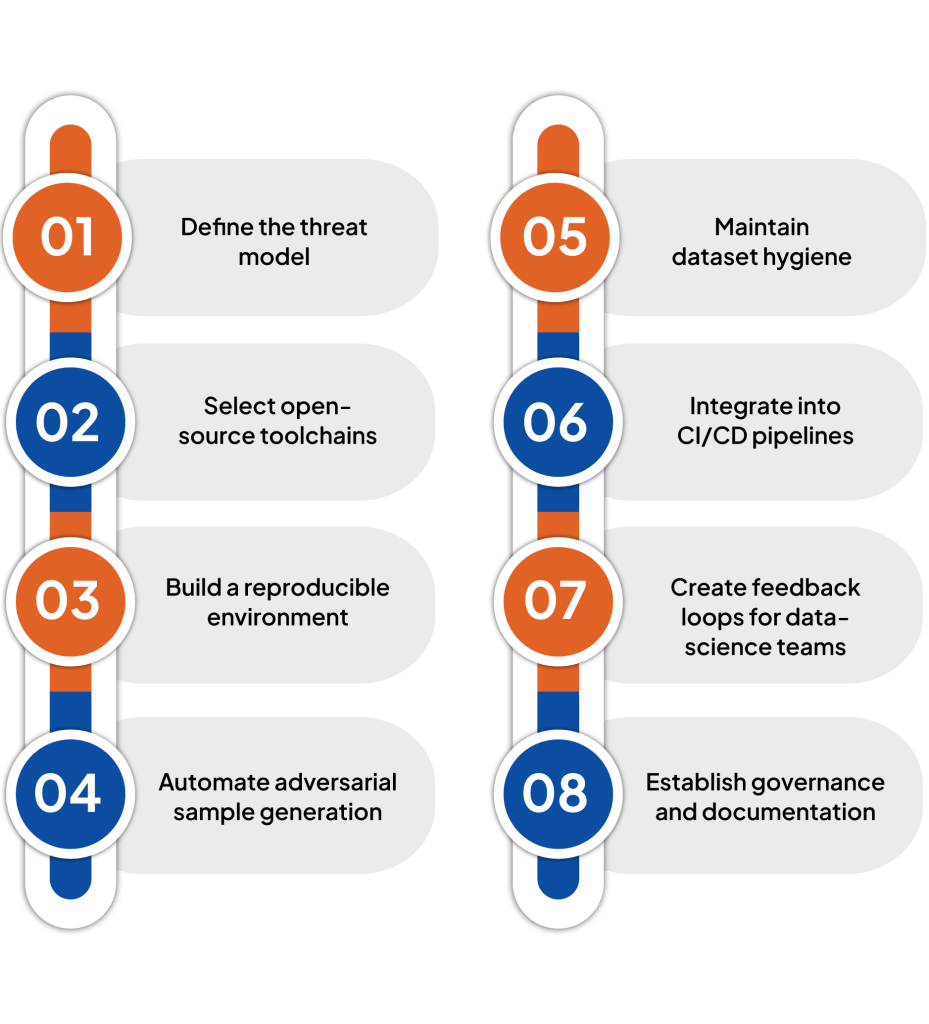
Step 1: Define the threat model
Before generating adversarial samples, clearly define what types of attacks your organization wants to simulate. A well-defined threat model ensures that testing aligns with real-world risks rather than theoretical extremes.
Threat modeling requires collaboration between security engineers, ML researchers, and product stakeholders. The objective is to determine what attackers might realistically attempt and what impact such attacks could have on the business.
Important threat dimensions include:
- White-box attacks where the attacker has full model knowledge
- Black-box attacks where the attacker only interacts through queries
- Targeted attacks that force a specific misclassification
- Untargeted attacks that cause any incorrect prediction
- Evasion attacks during inference
- Data poisoning attacks during training
Document assumptions such as model access level, API exposure, rate limits, and acceptable risk thresholds. This documentation becomes the foundation of your adversarial simulation strategy.
Step 2: Select open-source toolchains
Once the threat model is defined, select robust and well-maintained open-source libraries to power your lab. The right tooling accelerates development and ensures tested implementations of known attack techniques.
Popular options include:
- CleverHans (TensorFlow-based adversarial research library)
- Torchattacks (PyTorch-compatible adversarial attack collection)
- IBM Adversarial Robustness Toolbox (ART) (multi-framework support)
- Foolbox (robust benchmarking library for adversarial evaluation)
When choosing your stack, evaluate:
- Compatibility with existing ML frameworks
- Active community support and documentation
- Extensibility for custom attacks
- Batch-processing and automation capabilities
Standardizing tools across teams prevents fragmentation and ensures consistent robustness evaluation.
Step 3: Build a reproducible environment
Reproducibility is essential in adversarial research. Without controlled environments, results may vary between runs, making comparisons unreliable.
Start by containerizing your lab using Docker to lock down dependencies and runtime configurations. Pin library versions and maintain environment files such as requirements.txt or environment.yml. This eliminates inconsistencies across machines and teams.
Best practices include:
- Using Docker images for experiment isolation
- Tracking experiments with MLflow or similar tools
- Fixing random seeds for deterministic outputs
- Version-controlling datasets with DVC
Reproducibility ensures that any discovered vulnerability can be replicated, validated, and retested after remediation.
Step 4: Automate adversarial sample generation
With infrastructure in place, design an automated attack pipeline. Rather than manually generating adversarial samples, build scripts that systematically test models across attack types and parameter ranges.
The pipeline typically includes:
- Loading the trained model
- Selecting a clean validation dataset
- Applying attack algorithms (FGSM, PGD, etc.)
- Measuring performance degradation
- Logging results and storing perturbed samples
Key robustness metrics to monitor:
- Accuracy under attack
- Attack success rate
- Confidence score shifts
- Perturbation magnitude (L2 or L∞ norms)
Automation ensures consistency and allows adversarial testing to scale across multiple models and teams.
Step 5: Maintain dataset hygiene
Adversarial testing can quickly become unreliable if dataset management is neglected. Mixing clean and adversarial samples without tracking metadata can corrupt experiments and confuse training pipelines.
Clear separation between clean validation data and adversarial datasets is essential. Label all perturbed samples and store perturbation parameters alongside them. This supports traceability and future analysis.
Dataset hygiene best practices include:
- Maintaining isolated storage for adversarial samples
- Documenting perturbation strength and attack type
- Preserving original preprocessing pipelines
- Encrypting sensitive datasets
- Restricting access to authorized personnel
Strong data governance ensures that adversarial simulations remain controlled and compliant.
Step 6: Integrate into CI/CD pipelines
Adversarial testing becomes truly powerful when integrated into CI/CD workflows. Robustness evaluation should be treated as a release criterion, not an optional research activity.
When a new model version is committed, the CI pipeline can automatically trigger adversarial testing jobs. These jobs run attack scripts within containerized environments and compute robustness metrics. If performance drops below predefined thresholds, the build fails.
Example gating criteria:
- Clean accuracy ≥ baseline
- Adversarial accuracy ≥ defined robustness threshold
- No increase in attack success rate beyond tolerance
Tools such as GitHub Actions, GitLab CI, Jenkins, or Azure DevOps can automate this process. Over time, adversarial regression testing becomes a standard quality control mechanism.
Step 7: Create feedback loops for data-science teams
An adversarial simulation lab should not operate in isolation. Its insights must directly inform model improvement efforts.
Establish clear communication channels between the security and ML teams. Generate structured reports that include reproducible attack configurations and detailed robustness metrics. Automated alerts for failing robustness thresholds can accelerate remediation.
Feedback mechanisms may include:
- Weekly robustness dashboards
- Slack or email notifications for failed tests
- Automated issue tickets with attack parameters
- Recommendations for adversarial training
This continuous improvement loop gradually hardens models against adversarial attacks.
Step 8: Establish governance and documentation
Formal governance transforms your lab from an experimental initiative into a strategic security asset. Documentation should capture threat models, attack parameters, evaluation criteria, and retesting schedules.
Governance components should include:
- Standard operating procedures for attack testing
- Defined robustness benchmarks
- Incident response protocols
- Periodic audit reviews
- Version-controlled security updates
Clear governance ensures consistency across teams and supports regulatory compliance when required.
Conclusion
As machine learning becomes more deeply embedded in business, adversarial robustness needs to become a standard part of the ML lifecycle. An internal adversarial attack simulation lab allows companies to find weaknesses before their attackers do and to enforce security as an automated part of the ML lifecycle. By integrating reproducibility, automated attack simulators, good data hygiene, and CI/CD integration, companies can build adversarial robustness into their engineering culture. This will, over time, turn model robustness from a remediation into a competitive advantage.
Protect your machine learning systems from evolving adversarial attacks before they impact your business. With proactive adversarial testing, you can strengthen model resilience, reduce operational risk, and ensure regulatory confidence. ValueMentor helps enterprises design and implement robust adversarial attack simulation labs that integrate seamlessly into existing ML pipelines. Get in touch with us today and secure your AI systems with industry-proven adversarial defense strategies.
FAQS
1. Are adversarial attacks visible to humans?
Usually no. The changes are often too small for humans to notice but can mislead ML models.
2. Which industries are most at risk from adversarial attacks?
Finance, healthcare, autonomous vehicles, cybersecurity, and e-commerce are highly exposed.
3. Do small ML models face adversarial risks?
Yes. Both small and large models can be vulnerable if not tested properly.
4. Is adversarial testing expensive to implement?
It can be cost-effective when automated and integrated into existing ML workflows.
5. What is adversarial robustness?
It measures how well a model performs when exposed to maliciously modified inputs.
6. Can adversarial attacks happen after deployment?
Yes. Most real-world attacks occur during the inference stage.
7. Does encryption prevent adversarial attacks?
No. Encryption protects data in transit, but adversarial attacks target model behavior.
8. What is adversarial retraining?
It is the process of retraining a model using adversarial examples to improve robustness.
9. Should startups worry about adversarial attacks?
Yes. Any organization deploying ML in production should assess adversarial risks.
10. How do you measure attack success?
By calculating how often an adversarial input causes incorrect predictions.