
Digital Personal Data Protection Act (DPDP), 2023 is a landmark piece of legislation in the history of India with regard to privacy and data protection. It is not a mere statutory obligation for organizations but a business strategy. In view of the increasing dependence on digital technology by organizations for gathering and processing sensitive information, the DPDP Act provides an appropriate mechanism for protecting citizens’ interests and ensuring corporate accountability in relation to such data.
Be it an early-stage startup, SaaS provider, BFSI firm, or healthcare provider, knowing about DPDP compliance is essential for you. Not only will non-compliance bring along with it hefty fines and legal trouble, but it may also hamper the reputation of your company. In contrast, being compliant will create trustworthiness and ensure governance.
The guide will provide stepwise guidelines for complying with DPDP. Starting from requirements as per the Act, consent framework, to breach notification and readiness assessment, we will give you everything you need to know about DPDP compliance.
What is DPDP Act Compliance in India?
The Digital Personal Data Protection Act (DPDP), 2023 is India’s landmark legislation designed to regulate how personal data is collected, processed, stored, and shared. In simple terms, it ensures that individuals referred to as “data principals” retain control over their personal information, while businesses known as “data fiduciaries” are obligated to handle that data responsibly.
At its core, the DPDP Act emphasizes three pillars:
- Consent based data processing: Individuals must provide clear consent before their personal data is used.
- Transparency and accountability: Businesses must disclose how data is collected, processed, and shared.
- Rights of individuals: Citizens have the right to access, correct, and erase their personal data.
What Does “Compliance” Mean for Businesses?
For businesses, DPDP compliance means aligning internal policies, processes, and technologies with the Act’s requirements. Compliance involves:
Compliance is not a one‑time exercise; it requires continuous monitoring, audits, and governance frameworks to stay aligned with evolving regulations.
Who does the DPDP Act apply to?
The DPDP Act applies broadly to any organization that processes personal data in India, including:
Additionally, the Act introduces the concept of Significant Data Fiduciaries (SDFs) large organizations or those handling sensitive categories of data. SDFs face stricter obligations, such as mandatory audits, risk assessments, and appointment of a DPO.
Why DPDP Compliance matters for businesses
The DPDP compliance services in India is more than a legal requirement, it’s a business imperative. Companies that handle personal data must recognize the risks of ignoring compliance and the benefits of embracing it.
Legal Risks
Non‑compliance with the Digital Personal Data Protection Act Compliance India can expose businesses to regulatory investigations, lawsuits, and enforcement actions. The law empowers authorities to impose strict obligations on data fiduciaries, and failure to meet these obligations can result in legal liabilities that disrupt operations.
Financial Penalties
The DPDP Act prescribes hefty financial penalties for violations. Depending on the severity of the breach or non‑compliance, fines can reach into the crores of rupees. For startups and mid‑sized enterprises, such penalties can be devastating, while larger organizations risk shareholder backlash and loss of investor confidence.
Business Trust and Reputation
Compliance goes beyond penalty evasion; it means establishing trust with your customers and partners. In an era where the world is run by technology, consumers are becoming more conscious of their privacy and rights. A business that portrays effective compliance establishes its credibility, whereas any breaches can cause permanent loss of customers for such a business. Trust and reliability have always been the key to success in BFSI and healthcare sectors.
Who needs to comply with the DPDP Act?
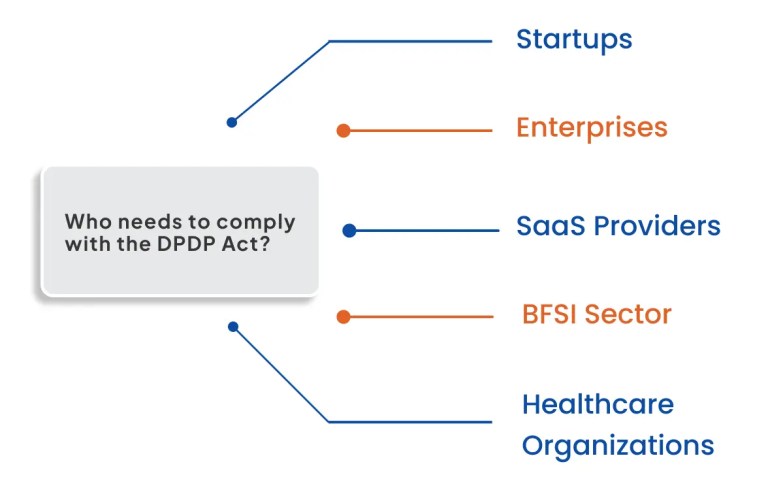
Any business that collects or processes personal data in India must comply with the DPDP Act.
This includes startups, enterprises, SaaS companies, banks, insurance firms, healthcare providers, and e-commerce platforms.
Startups
Even small startups collecting customer information through apps or websites fall under the Act. Whether it’s email addresses, phone numbers, or payment details, startups must implement data fiduciary compliance in India to avoid early‑stage risks.
Enterprises
Large corporations with complex data ecosystems face stricter obligations. Enterprises often qualify as Significant Data Fiduciaries (SDFs) due to the scale and sensitivity of data they process. For them, compliance involves mandatory audits, risk assessments, and appointment of a Data Protection Officer (DPO).
SaaS Providers
Software‑as‑a‑Service companies routinely process personal data for clients. From CRM platforms to HR tools, SaaS providers must ensure DPDP consultant‑led compliance to maintain credibility and avoid liability for client data breaches.
BFSI Sector
Financial and insurance companies deal with sensitive financial information, as well as identity data. Compliance is a must for BFSI organizations since regulators keep a close eye on such companies and India DPDP compliance solutions are necessary for the continued operation and licensing of the company.
Healthcare Organizations
Organizations operating hospitals, clinics, and even telemedicine applications work with sensitive personal information as part of their daily processes. Such companies should have a strict compliance framework that ensures DPDP standards and personal data security.
In general, any company that stores and processes personal data should be compliant with the Act. Regardless of whether your company belongs to eCommerce, education, healthcare, logistics, or another field, compliance is inevitable.
Key requirements under the DPDP Act
The DPDP Act requirements India outline specific obligations for businesses that collect, process, or store personal data. These requirements ensure transparency, accountability, and protection of individual rights. Below are the key compliance areas every organization must address.
Who is a Data Fiduciary?
Under the DPDP Act, a data fiduciary obligations India DPDP is any entity that determines the purpose and means of processing personal data. This includes businesses, startups, SaaS providers, and financial institutions.
The Act also introduces Significant Data Fiduciaries (SDFs) organizations that process large volumes of sensitive personal data or have a significant impact on national interests. SDFs face stricter obligations, such as:
• Mandatory data protection impact assessments.
• Appointment of a Data Protection Officer (DPO).
• Regular compliance audits.
For businesses, understanding whether they qualify as an SDF is critical, as it directly impacts compliance costs and governance requirements.
Consent Management Requirements
Consent is the cornerstone of the DPDP Act. Businesses must ensure that individuals provide clear, informed, and revocable consent before their personal data is processed.
Key obligations include:
Granular consent
Users must be able to consent to specific purposes, not blanket approvals.
Easy withdrawal
Individuals should be able to revoke consent as easily as they gave it.
Transparent notices
Companies must disclose how data will be used, stored, and shared.
Failure to implement robust consent management systems can lead to violations and penalties. For SaaS providers and e‑commerce platforms, this often requires technology solutions that track and manage user consent across multiple touchpoints.
Data Processing Rules
The provisions laid down under the DPDP compliance Act are stringent in nature concerning the processing of personal data:
- Purpose restriction: The use of personal data must conform to the reason the data subject has given consent.
- Data minimization: Obtain data that is only needed for the functioning of the company.
- Storage restriction: Personal data should not be stored beyond its utility period.
- Security: Technical and organizational means must be taken by companies to prevent data leakage.
These restrictions are imposed upon both data fiduciaries as well as data processors (any third party processing data on behalf of data fiduciaries).
Data Protection Officer (DPO) Role
For Significant Data Fiduciaries, appointing a Data Protection Officer (DPO) is mandatory. The DPO acts as the compliance lead, responsible for:
- Monitoring internal data practices.
- Ensuring adherence to DPDP requirements.
- Serving as the point of contact for the Data Protection Board of India.
- Handling grievances and data subject requests.
Even for smaller organizations, appointing a DPO or compliance lead is recommended to centralize accountability and streamline compliance efforts.
DPDP Data Subject Rights Explained
One of the most important aspects of the Digital Personal Data Protection Act (DPDP), 2023 is the empowerment of individuals known as data principals with clear rights over their personal information. For businesses, understanding and enabling these rights is central to DPDP compliance in India. Failure to respect these rights can lead to penalties, reputational damage, and loss of customer trust.
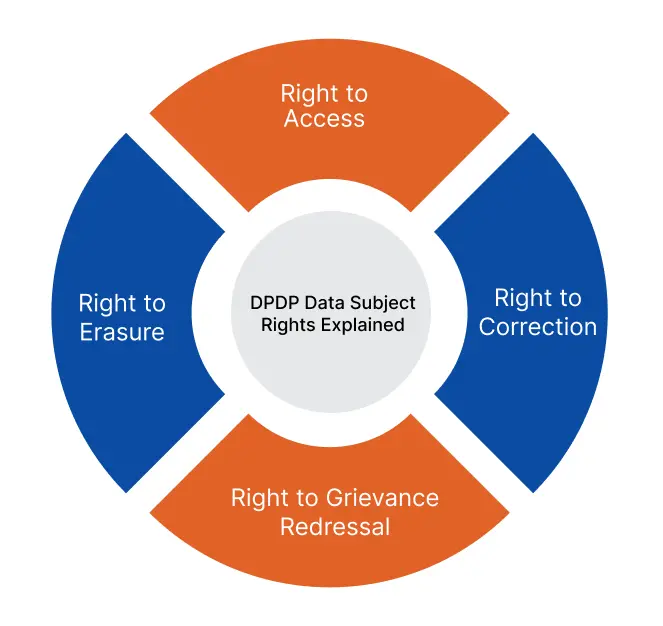
Right to Access
Data principals have the right to access their personal data held by a business. This means organizations must provide:
What to Do:
For compliance, businesses must establish user‑friendly mechanisms such as online portals or dashboards where individuals can request and view their data.
Right to Correction
Individuals can demand correction of inaccurate or incomplete personal data. Businesses must ensure that data is updated promptly and accurately.
For Example:
Organizations must implement data validation processes and workflows to handle correction requests efficiently.
Right to Erasure
Also known as the “right to be forgotten,” this provision allows individuals to request deletion of their personal data when:
For example:
Businesses must have secure deletion protocols and ensure that erased data cannot be recovered or misused. This is particularly critical for industries like BFSI and healthcare, where sensitive data is often stored across multiple systems.
Right to Grievance Redressal
The DPDP Act requires businesses to establish a grievance redressal mechanism. It is essential that data principals can:
For compliance, companies should appoint a Grievance Officer or integrate grievance handling into the responsibilities of the Data Protection Officer (DPO).
DPDP Breach Notification Requirements
One of the most critical obligations under the Digital Personal Data Protection Act (DPDP), 2023 is the requirement for businesses to report data breaches. The law recognizes that breaches can have severe consequences for individuals and mandates strict reporting protocols to ensure transparency and accountability.
Reporting Timelines
Under the DPDP Act, businesses must notify the Data Protection Board of India of any personal data breach as soon as possible. While the Act does not prescribe an exact number of hours, the expectation is that reporting should be prompt and without undue delay.
Authority Reporting
When a breach occurs, businesses must provide detailed information to the authorities, including:
The Data Protection Board of India may then issue directions, such as requiring the company to inform affected individuals or take corrective measures.
For Significant Data Fiduciaries (SDFs), reporting obligations are even stricter, with mandatory audits and compliance reviews following a breach.
Business Impact
Beyond regulatory obligations, breaches have significant business consequences:
Key focus Areas:
Financial losses
Costs of remediation, legal fees, and potential fines.
Operational disruption
Investigations and corrective actions can slow down business processes.
For industries like BFSI and healthcare, where sensitive data is involved, breaches can lead to long‑term trust deficits that are difficult to repair.
Why Breach Notification matters?
Transparent breach notification is not just a legal requirement it’s a trust‑building exercise. Customers are more likely to forgive a company that promptly discloses a breach and takes corrective action than one that hides incidents.
By complying with DPDP breach notification requirements, businesses can:
- Minimize regulatory penalties.
- Maintain customer confidence.
- Demonstrate proactive governance.
Need help with DPDP compliance?
DPDP Compliance checklist for businesses in India
For organizations preparing to meet the Digital Personal Data Protection Act (DPDP), 2023 requirements, a structured checklist is essential. A compliance checklist helps businesses identify gaps, prioritize actions, and ensure readiness before audits or regulatory reviews. Below is a practical framework tailored for general businesses and the BFSI sector.
General Business Checklist
Every company handling personal data in India should begin with these foundational steps:
Data Mapping & Inventory
Consent Management
Privacy Policy & Notices
Data Subject Rights Enablement
Security Controls
Incident Response Plan
Training & Awareness
DPDP readiness checklist for banks
The BFSI sector faces heightened scrutiny due to the sensitivity of financial data. Banks and financial institutions should adopt additional measures:
Customer Data Segmentation
Enhanced Consent Frameworks
Fraud Detection & Monitoring
Audit & Certification
Third Party Vendor Management
Customer Grievance Redressal
A DPDP readiness checklist bank provides businesses with a clear roadmap.
DPDP Readiness Assessment and Gap Analysis
For businesses preparing to comply with the Digital Personal Data Protection Act (DPDP), 2023, a readiness assessment is the first step toward building a sustainable compliance framework. It helps organizations evaluate their current data practices, identify gaps, and prioritize corrective measures. Without this structured approach, compliance efforts can become fragmented and ineffective.
What is a Gap Analysis?
A DPDP compliance gap analysis is a systematic review of how your organization’s existing data protection policies, processes, and technologies align with the requirements of the DPDP Act.
It involves:
DPDP audit and gap analysis India is not just about finding weaknesses it’s about creating a roadmap for compliance success.
Why businesses need it?
Conducting a DPDP readiness assessment India is critical for several reasons:
Regulatory Preparedness
Risk Mitigation
Operational Efficiency
Customer Trust
For industries like BFSI and healthcare, where regulators closely monitor compliance, readiness assessments are often mandatory or strongly recommended.
Expected Outcomes
A well‑executed readiness assessment delivers actionable insights, including:
Compliance Scorecard
Gap Report
Prioritized Action Plan
Resource Planning
Audit Readiness
By investing in readiness assessments, businesses can avoid last‑minute compliance scrambles and build a culture of continuous data protection.
Start your DPDP compliance journey now.
Request a readiness assessment and identify your compliance gaps before regulators do.
Common challenges in DPDP Compliance
While the Digital Personal Data Protection Act (DPDP), 2023 provides a clear framework, many businesses struggle with implementation. Compliance is not just about policies it requires operational changes, technology upgrades, and cultural shifts. Below are the most common challenges organizations face when working toward India data privacy compliance consultancy standards.
Data Discovery and Mapping
One of the biggest hurdles is data discovery. Personal data is often spread across multiple systems, applications, and third‑party platforms.
- Legacy systems may store data in fragmented formats.
- Cloud services add complexity with distributed storage.
- Third‑party integrations create blind spots in data flows.
Without a comprehensive data inventory, businesses cannot accurately assess risks or implement compliance measures. This makes data mapping a critical first step, but also one of the most resource‑intensive.
Consent Management Issues
Tracking user consent is another major challenge. Many businesses rely on outdated systems that cannot handle granular or revocable consent.
- Customers may give consent on one platform but withdraw it on another.
- Businesses often lack centralized tools to synchronize consent across systems.
- Manual tracking leads to errors and non‑
For SaaS providers and e‑commerce platforms, DPDP consent management requirements technology solutions that integrate seamlessly with customer journeys.
Lack of Internal Expertise
Compliance is not just a legal issue it requires technical, operational, and governance expertise. Many organizations struggle because:
- Teams are not fully aware of DPDP obligations.
- Compliance responsibilities are scattered across departments.
- There is no dedicated Data Protection Officer (DPO) or compliance lead.
This lack of expertise often results in reactive compliance, where businesses only act after facing regulatory pressure. Partnering with a DPDP consultant for businesses in India can bridge this gap.
Technology Gaps
Even when businesses understand the requirements, they often lack the tools to implement them. Common technology gaps include:
- Consent management platforms to track approvals.
- Monitoring systems to detect breaches in real time.
- Audit tools to demonstrate compliance to regulators.
Without the right technology stack, compliance becomes manual, error‑prone, and unsustainable.
Step by Step DPDP Compliance Implementation Roadmap
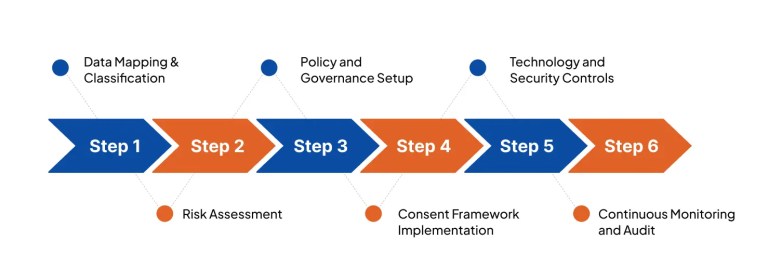
Achieving DPDP compliance in India requires more than just understanding the law—it demands a structured, step-by-step approach. Whether you’re working with internal teams or DPDP implementation partners, following a clear roadmap ensures that compliance is systematic, scalable, and sustainable. Below is a practical framework for organizations seeking DPDP compliance solution India.
Step 1: Data Mapping & Classification
The first step is to identify and classify all personal data within the organization.
Data inventory
Classification
Ownership
This step ensures businesses understand the scope of compliance obligations.
Step 2: Risk Assessment
Once data is mapped, conduct a risk assessment to evaluate vulnerabilities.
For Significant Data Fiduciaries (SDFs), risk assessments are mandatory and must be reported to regulators.
Step 3: Policy and Governance Setup
Compliance requires strong governance frameworks.
Step 4: Consent Framework Implementation
Consent is the foundation of DPDP compliance.
For SaaS providers and e‑commerce platforms, consent frameworks must integrate seamlessly into customer journeys.
Step 5: Technology and Security Controls
Compliance is impossible without robust technology safeguards.
Technology investments are often the largest cost drivers in compliance but are essential for sustainability.
Step 6: Continuous Monitoring and Audit
Compliance is not a one‑time exercise; it requires ongoing vigilance.
Continuous monitoring ensures businesses remain compliant even as data practices change.
For many companies, working with a DPDP service provider can accelerate implementation and ensure nothing is overlooked.
DPDP Compliance Cost & Timeline in India
While compliance may seem like a regulatory burden, it offers significant business advantages. Implementing Bahrain data protection compliance services can transform compliance into a strategic asset.
Cost Drivers
The overall DPDP compliance cost India varies widely, but several factors consistently influence the budget:
Organization Size & Industry
Larger enterprises and regulated industries (BFSI, healthcare, SaaS) face higher costs due to stricter obligations and larger data volumes.
Data Complexity
Businesses with fragmented data across multiple systems require more resources for data discovery, mapping, and classification.
Technology Investments
Implementing consent management platforms, encryption tools, monitoring systems, and audit solutions often represents the largest expense.
Human Resources
Hiring or appointing a Data Protection Officer (DPO), training employees, and engaging external consultants add to compliance costs.
Audit & Certification
Significant Data Fiduciaries (SDFs) must undergo regular audits, which involve additional fees for certification and external reviews.
Third‑Party Vendor Management
Reviewing and updating contracts with vendors, processors, and partners to align with DPDP requirements can increase legal and administrative costs.
For startups, costs may be relatively modest if they adopt compliance frameworks early. For enterprises, investments can run into lakhs or crores of rupees, depending on scale and complexity.
Timeline Phases
The DPDP compliance timeline India typically unfolds in structured phases. While exact durations vary, most organizations can expect a 6–12 month journey.
Phase 1: Readiness Assessment (1–2 months)
Conduct gap analysis, compliance scorecards, and risk assessments. Identify immediate vulnerabilities and prioritize actions.
Phase 2: Policy & Governance Setup (1–2 months)
Draft privacy policies, establish governance committees, and appoint a DPO. Begin employee training programs.
Phase 3: Technology Implementation (2–4 months)
Deploy consent management systems, encryption tools, monitoring platforms, and audit solutions. Integrate compliance into customer journeys.
Phase 4: Operational Integration (2–3 months)
Align business processes with DPDP requirements. Update contracts, vendor agreements, and grievance redressal mechanisms.
Phase 5: Continuous Monitoring & Audit (Ongoing)
Conduct regular audits, monitor systems for breaches, and update policies as regulations evolve. Compliance becomes a continuous cycle rather than a one‑time project.
Without clear planning, businesses risk underestimating the resources required for compliance. This can lead to rushed implementations, incomplete frameworks, and exposure to penalties.
DPDP Consulting and Compliance Services in India
For many organizations, achieving compliance with the Digital Personal Data Protection Act (DPDP), 2023 requires external expertise. The law introduces complex obligations around consent, governance, breach notifications, and audits areas where specialized consultants can accelerate readiness. Partnering with a DPDP consultant India ensures businesses not only meet legal requirements but also build sustainable compliance frameworks.
Advisory Services
Consultants provide strategic advisory services to help businesses interpret the DPDP Act and translate it into actionable steps
- Assess organizational readiness.
- Define compliance strategies tailored to industry needs.
- Provide guidance on whether a business qualifies as a Significant Data Fiduciary (SDF).
- Recommend governance structures and policies.
Advisory services are especially valuable for startups and enterprises that lack internal expertise.
Audit & Certification
Compliance is not complete without audits and certifications. Consultants help businesses:
- Conduct internal audits to identify gaps.
- Prepare documentation for regulatory reviews.
- Obtain certifications that demonstrate compliance to customers and partners.
- Establish ongoing audit cycles for continuous monitoring.
For BFSI and healthcare organizations, regular audits are critical to maintaining licenses and regulatory trust.
Technology Implementation
Consultants also assist with technology deployment, ensuring businesses have the right tools to meet DPDP obligations.
- Implement consent management platforms.
- Deploy data classification and discovery tools.
- Integrate breach detection and monitoring systems.
- Configure audit trails for transparency.
Technology implementation bridges the gap between policy and practice, making compliance operationally feasible.
Ongoing Compliance Support
DPDP compliance is not a one‑time project; it requires continuous monitoring and support. Consultants provide:
- Regular updates as regulations evolve.
- Employee training and awareness programs.
- Continuous monitoring of systems for breaches.
- Advisory support for new business initiatives involving personal data.
This ongoing support ensures businesses remain compliant even as their operations expand or regulations change.
Request a consultation and identify your compliance gaps with expert guidance.
Request a readiness assessment and identify your compliance gaps before regulators do.
How to choose the Right DPDP Compliance partner
One of the biggest challenges for organizations is to choose the right partner for DPDP compliance in India. Due to the number of vendors and consultants providing services, companies need to be able to identify who among them can provide sustainable DPDP compliance services. Choosing the wrong partner can result in wastage of company resources and even penalties. The following is a guideline on how to choose DPDP compliance vendors in India.
Vendor Checklist
Key qualities to seek in potential partners include:
Proven Expertise
Experience in data privacy laws, cybersecurity, and compliance frameworks.
Industry Knowledge
Familiarity with sector‑specific requirements (BFSI, healthcare, SaaS).
Comprehensive Services
Ability to provide advisory, audit, technology implementation, and ongoing support.
Technology Capabilities
Access to consent management platforms, monitoring tools, and audit systems.
Regulatory Alignment
Understanding the DPDP Act’s obligations, including requirements for Significant Data Fiduciaries (SDFs).
Client References
Case studies or testimonials from businesses that have successfully achieved compliance.
Red Flags
Not all vendors are equal. Watch out for warning signs such as:
Generic Solutions
One‑size‑fits‑all approaches that ignore industry nuances.
Lack of Transparency
Vendors are unwilling to share methodologies or compliance frameworks.
Limited Technology
Partners who rely solely on manual processes without scalable tools.
No Ongoing Support
Consultants who treat compliance as a one‑time project rather than a continuous cycle.
Unrealistic Promises
Guarantees of “instant compliance” or timelines that seem too short to be credible.
Questions to Ask
Before finalizing a partner, businesses should ask:
- What industries have you worked with for DPDP compliance?
- Do you provide both advisory and technology implementation services?
- How do you handle consent management and breach notification requirements?
- What is your approach to readiness assessments and gap analysis?
- How do you ensure ongoing compliance as regulations evolve?
- Can you provide references from clients in similar industries?
These questions help businesses evaluate whether a vendor can deliver long‑term compliance success rather than short‑term fixes.
How ValueMentor supports DPDP Compliance
Navigating the complexities of the Digital Personal Data Protection Act (DPDP), 2023 requires more than just awareness; it demands expertise, technology, and ongoing support. ValueMentor is recognized as one of the best DPDP compliance service providers in India, offering end‑to‑end solutions that help businesses achieve and sustain compliance. From DPDP advisory to monitoring, ValueMentor delivers a comprehensive framework tailored to industry needs.
Consulting & Advisory
ValueMentor begins by helping organizations define their compliance strategy.
- Interpret DPDP obligations in the context of your industry.
- Provide tailored DPDP advisory services for startups, enterprises, BFSI, SaaS, and healthcare.
- Guide businesses on whether they qualify as Significant Data Fiduciaries (SDFs).
- Recommend governance structures, policies, and consent frameworks.
This strategic foundation ensures businesses start their compliance journey with clarity and confidence.
Readiness Assessment & Gap Analysis
ValueMentor begins by helping organizations define their compliance strategy.
- Interpret DPDP obligations in the context of your industry.
- Provide tailored DPDP advisory services for startups, enterprises, BFSI, SaaS, and healthcare.
- Guide businesses on whether they qualify as Significant Data Fiduciaries (SDFs).
- Recommend governance structures, policies, and consent frameworks.
By identifying gaps early, businesses can avoid last‑minute compliance scrambles and build a proactive roadmap.
Implementation Support
Compliance requires operational execution, and ValueMentor provides hands‑on support.
- Draft and implement privacy policies aligned with DPDP.
- Deploy consent management systems and integrate them into customer journeys.
- Establish governance frameworks, including appointment of a Data Protection Officer (DPO).
- Configure technology safeguards such as encryption, monitoring, and audit systems.
This ensures compliance is not just theoretical but embedded into daily operations.
Ongoing Monitoring
ValueMentor offers continuous compliance tracking to keep businesses aligned with evolving regulations.
- Conduct regular audits and compliance reviews.
- Monitor systems for breaches and unauthorized access.
- Provide updates as DPDP regulations evolve.
- Deliver employee training and awareness programs.
Ongoing monitoring transforms compliance into a sustainable business advantage, reducing risks and strengthening customer trust.
Best DPDP Compliance Solutions & Platforms in India
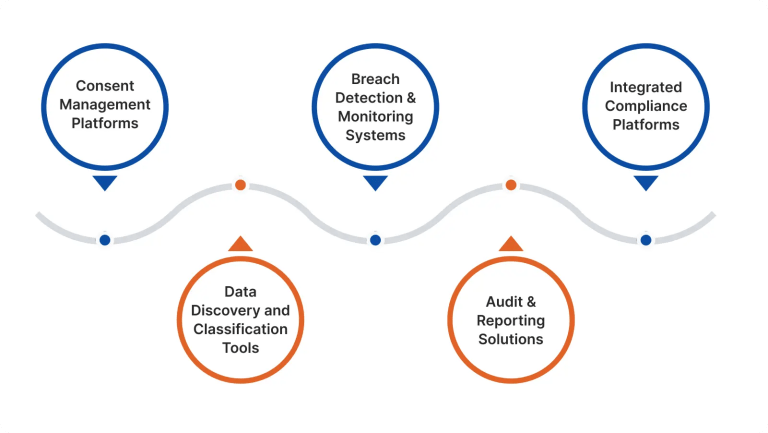
Whereas advisory and India DPDP compliance services offer the strategic blueprint, organizations also require technology solutions to put the implementation of compliance into practice under the DPDP act 2023. Getting the right technology solution helps integrate functions such as consent management, data discovery, breach detection, and audit reporting into your day-to-day operations. Selecting the ideal DPDP solution provider in India is key to achieving success.
Consent Management Platforms
Consent forms the cornerstone of DPDP compliance. Platforms designed for consent management help businesses:
- Capture granular, informed consent across multiple channels.
- Track consent status in real time.
- Provide easy withdrawal mechanisms for users.
- Integrate consent workflows into websites, apps, and SaaS platforms.
These platforms reduce manual errors and ensure businesses can demonstrate compliance during audits.
Data Discovery and Classification Tools
Compliance begins with knowing where personal data resides. Data discovery tools:
- Map personal data across legacy systems, cloud platforms, and third‑party integrations.
- Classify data based on sensitivity (financial, health, identity).
- Provide dashboards for compliance teams to monitor data flows.
For BFSI and healthcare organizations, these tools are critical to managing sensitive records securely.
Breach Detection & Monitoring Systems
The DPDP Act requires prompt breach notifications. Monitoring platforms help businesses:
- Detect unauthorized access or suspicious activity in real time.
- Generate automated alerts for compliance teams.
- Provide forensic reports for regulatory submissions.
- Integrate with incident response workflows.
These systems minimize the impact of breaches and demonstrate proactive governance.
Audit & Reporting Solutions
Audits are central to DPDP compliance, especially for Significant Data Fiduciaries (SDFs). Audit platforms:
- Generate compliance reports for regulators.
- Provide evidence of consent, breach notifications, and grievance redressal.
- Support continuous monitoring and certification cycles.
These systems minimize the impact of breaches and demonstrate proactive governance.
Integrated Compliance Platforms
Some vendors offer end‑to‑end compliance platforms that combine consent management, data discovery, breach monitoring, and audit reporting into a single solution. These platforms:
- Provide scalability for startups and enterprises alike.
- Reduce costs by consolidating multiple tools.
- Offer dashboards for compliance officers and executives.
- Enable continuous compliance tracking.
Integrated platforms are often the best DPDP compliance solutions in India for businesses seeking efficiency and simplicity.
Industries impacted by DPDP Act
This law is applicable across various sectors for all companies that deal with personal data in India. Yet, some industries will have additional considerations regarding the DPDP Act since there will be more data sensitivity and greater amount of data being processed in them.
BFSI (Banking, Financial Services, and Insurance)
The BFSI industry is one of those industries which will be significantly affected by the DPDP Act.
Sensitive data
Banking and insurance companies hold data about customers’ accounts, transactions, and identification details.
High level of regulation
Since the regulation in this field is high, any violation will be considered very serious.
Trust
The reputation of financial institutions depends on their customer’s trust.
For BFSI, data fiduciary compliance India is not optional, it is mission‑critical.
SaaS Providers
Software‑as‑a‑Service companies process personal data for clients across industries.
Multi‑tenant environments
SaaS platforms often store data for multiple customers, increasing complexity.
Consent management
SaaS providers must integrate consent frameworks into applications.
Third‑party integrations
SaaS solutions often connect with external tools, requiring strict vendor compliance.
Compliance ensures SaaS providers remain competitive and trustworthy in global markets.
Healthcare
Healthcare organizations handle some of the most sensitive categories of personal data.
Patient records
Medical histories, prescriptions, and diagnostic data require strict confidentiality.
Telemedicine platforms
Online healthcare services must implement secure consent and grievance mechanisms.
Regulatory overlap
Healthcare providers often face additional obligations under sector‑specific laws.
For healthcare, DPDP compliance is essential to protect patient privacy and maintain regulatory approval.
E Commerce & Retail
E‑commerce platforms collect vast amounts of customer data, including payment details and purchase histories.
Consent tracking
Customers must be informed about how their data is used for marketing and personalization.
Vendor management
Platforms must ensure third‑party sellers comply with DPDP obligations.
Breach risks
Payment data breaches can lead to severe penalties and reputational damage.
Compliance helps e‑commerce businesses build trust and loyalty among customers.
Education & EdTech
Educational institutions and EdTech platforms process student data, including identity, academic records, and financial information.
Parental consent
Special obligations apply when handling data of minors.
Data minimization
Institutions must ensure only necessary data is collected.
Vendor oversight
EdTech platforms must ensure compliance across learning management systems and third‑party tools.
Compliance strengthens credibility and ensures safe digital learning environments.
Penalties for Non Compliance under DPDP Act
The Digital Personal Data Protection Act (DPDP), 2023 introduces strict enforcement mechanisms to ensure businesses take compliance seriously. Non‑compliance can result in significant financial penalties, reputational damage, and operational disruptions. Understanding the consequences is critical for organizations aiming to avoid risks and build trust.
Financial Penalties
The DPDP Act empowers the Data Protection Board of India to impose fines for violations.
Minor violations
(e.g., failure to update privacy notices) may attract smaller penalties.
Major breaches
(e.g., unauthorized disclosure of sensitive data, failure to notify breaches) can result in fines running into crores of rupees.
Trust
Penalties are proportionate to the severity of the violation and the scale of data affected.
For startups, even modest fines can be devastating. For enterprises, large penalties can impact shareholder confidence and market reputation.
Enforcement Actions
Beyond financial penalties, the Data Protection Board can take enforcement actions such as:
Directives to cease processing certain categories of data.
Mandatory corrective measures to address compliance gaps.
Suspension of operations involving personal data until compliance is restored.
These actions can disrupt business continuity, especially for industries like BFSI and healthcare where data processing is integral to operations.
Reputational Damage
Non‑compliance is not just a legal issue it’s a reputational risk.
Breaches or compliance failures can lead to loss of trust and customer churn.
Negative media coverage can damage brand credibility for years.
For businesses in competitive markets, reputational damage can be more costly than financial penalties.
Operational Impact
Compliance failures often trigger internal disruptions:
Emergency audits and investigations.
Resource diversion from growth initiatives to remediation.
Increased scrutiny from regulators and partners.
These operational impacts slow down business momentum and increase costs.
Future of data privacy Compliance in India
The Digital Personal Data Protection Act (DPDP), 2023 is not a static regulation; it marks the beginning of a new era in India’s digital governance. As businesses adapt to compliance requirements, the future will bring evolving obligations, global alignment, and new opportunities for organizations that embrace data protection as a strategic priority.
Evolving Regulations
The DPDP Act is expected to evolve as technology and business models change.
New guidelines
Expanded obligations
Continuous updates
This means compliance is not a one‑time project but an ongoing journey.
Global Alignment
India’s DPDP Act aligns with global data protection trends, such as the EU’s GDPR and other international frameworks.
Cross border data flows:
Competitive advantage:
Standardization:
Global alignment positions Indian businesses as credible players in the international digital economy.
Business Opportunities
Compliance is often seen as a cost, but it also creates opportunities.
Customer trust:
Partnerships:
Innovation:
For startups and enterprises alike, compliance can become a growth driver rather than a burden.
Technology Integration
The future of compliance lies within technology.
Automation:
Scalability:
Monitoring:
Technology is going to change compliance into an automated, fully-integrated part of business processes.
FAQs
1. What is DPDP compliance in India?
DPDP compliance refers to following the rules set under the Digital Personal Data Protection Act, 2023, which governs how businesses collect, process, store, and protect personal data of individuals in India.
2. Who needs to comply with the DPDP Act?
Any business or organization that handles digital personal data—whether startups, SaaS companies, enterprises, or financial institutions must comply with the DPDP Act, regardless of size.
3. What are the key DPDP requirements?
Key requirements include obtaining user consent, ensuring secure data processing, enabling data subject rights, reporting breaches, and implementing proper governance and data protection measures.
4. How long does DPDP compliance take?
Start with a data audit, conduct a gap analysis, implement policies, and train employees.
5. What is the cost of DPDP compliance?
Costs vary based on factors like company size, data volume, technology needs, and consulting support. Startups may incur moderate costs, while large enterprises may require higher investment.
6. What is a data fiduciary?
A data fiduciary is an organization or entity that decides how and why personal data is collected and processed. They are primarily responsible for ensuring compliance with the DPDP Act.
7. Is DPDP compliance mandatory?
Yes, DPDP compliance is mandatory for any organization processing personal data of individuals in India. Non-compliance can lead to penalties and regulatory action.
8. What happens if a company fails to comply?
Failure to comply can result in heavy financial penalties, legal consequences, reputational damage, and potential restrictions on data processing activities.
9. What is a DPDP readiness assessment?
A readiness assessment evaluates your current data protection practices and identifies gaps compared to DPDP requirements, helping create a roadmap for compliance.
10. Do startups need DPDP compliance?
Yes, startups must comply if they collect or process personal data even basic information like emails or phone numbers. Compliance requirements apply regardless of business size.